
How collectible stores can run fairer limited releases
A limited release is a promise: a fixed number of items, sold to as many different people as possible, without one buyer hoovering up the lot to flip. Nothing makes that promise perfectly enforceable — but you can stack a few honest tactics that, together, make your drop meaningfully fairer. Here’s the playbook, with the trade-offs spelled out so you can pick what fits your store.
What “fair” actually means for a drop
It helps to be precise. “Fair” usually means some mix of:
- Breadth — the run reaches as many distinct collectors as possible.
- No bulk-flipping — one person can’t buy ten and resell them at 3×.
- No bot advantage — a human with a normal connection has a real shot.
- No accidental lockouts — an honest buyer isn’t punished for a refreshed page or a failed first payment.
Notice those can conflict. The tightest anti-flip rule (1 per customer, accounts required, manual review) also creates the most friction and accidental lockouts. The playbook below is about choosing where on that spectrum your store wants to sit.
Layer 1: a hard per-customer cap
This is the single highest-leverage move, and the cheapest. A lifetime per-customer limit means a buyer gets their one (or two, or three) — across every order, not just one cart — and then they’re done. It directly attacks bulk-flipping by the same person.
The important nuance, which trips up a lot of stores: WooCommerce’s built-in “Sold individually” only limits one cart. A determined buyer just checks out twice. To enforce a real per-customer cap you have to look at the customer’s order history — matched by account for logged-in buyers and by billing email for guests. We cover the mechanics in limiting a product to one per customer and the guest-specific case.
Trade-off: email-based caps don’t stop someone using a fresh email and a new card. That’s a real ceiling — but the cap still removes the laziest and most common form of bulk-buying, which is one account or one email grabbing many.
Layer 2: set expectations before the drop
A surprising amount of “abuse” is just honest confusion. Make the rule impossible to miss:
- Put “Limit 1 per customer” on the product page, the drop announcement, and the email.
- Show the limit as a badge near the add-to-cart button so it’s seen at the decision moment, not buried in fine print.
- Write the blocked-purchase message in your own voice — “Only one Drop V2 per collector, thanks for keeping it fair” converts a blocked buyer into a fan instead of an angry ticket.
Trade-off: none, really. Clear communication is free and reduces support load. Do this even if you do nothing else.
Layer 3: slow the bots down
Per-customer caps don’t stop automated checkout running many identities. If bots are a real problem for your store, add friction at the edge:
- A CAPTCHA or challenge at checkout (hCaptcha, Cloudflare Turnstile). Cheap, catches naive bots.
- Cloudflare Bot Management / rate limiting in front of the store, so a single IP can’t hammer the checkout endpoint.
- A short randomized queue at drop time so everyone hits “buy” against the same starting gun rather than rewarding whoever scripted the fastest request.
Trade-off: friction and false positives. Aggressive bot rules occasionally block real customers on shared IPs or strict privacy setups. Tune conservatively and watch your support inbox during the first drop.
Layer 4: keep a manual review & cancel option
For high-value chase variants, some stores intentionally let orders through and then review the first wave for obvious abuse — ten orders to ten near-identical emails at the same address, for instance — and cancel + refund the duplicates. Your per-customer cap plus a blocked-attempt log makes these patterns easy to spot.
Trade-off: labor and judgment calls. Cancelling a paid order risks an unhappy customer and a chargeback if you get it wrong. Reserve this for clear-cut cases and document your policy publicly so it’s defensible.
A realistic stack for most stores
You don’t need all four layers. For a typical collectible store running monthly chase variants, this is a sensible default:
- Hard per-customer cap (1–2 per product, across all orders, guests + accounts).
- Visible badge + clear messaging on the product, email, and socials.
- A checkout CAPTCHA if you’ve seen bot activity; skip it until you have.
- A glance at the blocked-attempt log after each drop to spot patterns — escalate to manual review only if something’s obviously off.
That’s most of the fairness benefit for a fraction of the friction of going maximal.
DropLock handles layers 1 and 2 in one toggle
Lifetime per-customer caps (guests + accounts), a customizable product badge, your own blocked message, and a log you can review after each drop. Pair it with a CAPTCHA for bots. 14-day refund.
See pricing — from $49 →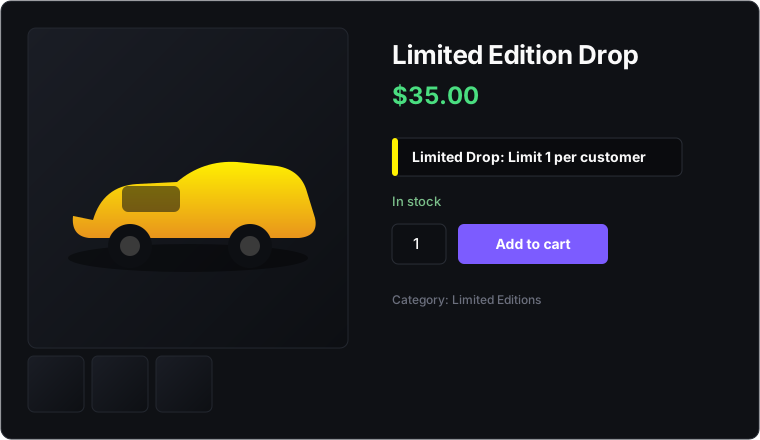
After the drop: turn data into fairness
The drop isn’t over when it sells out. Two quick habits compound over time:
- Review the blocked-attempt log. Honest repeat-buyers are a marketing list (“sorry you missed it — here’s early access next time”). Suspicious patterns inform your next drop’s defenses.
- Publish the outcome. “X units, sold to Y distinct collectors” builds trust and signals that your drops are worth showing up for — which is the whole point of running them fairly.